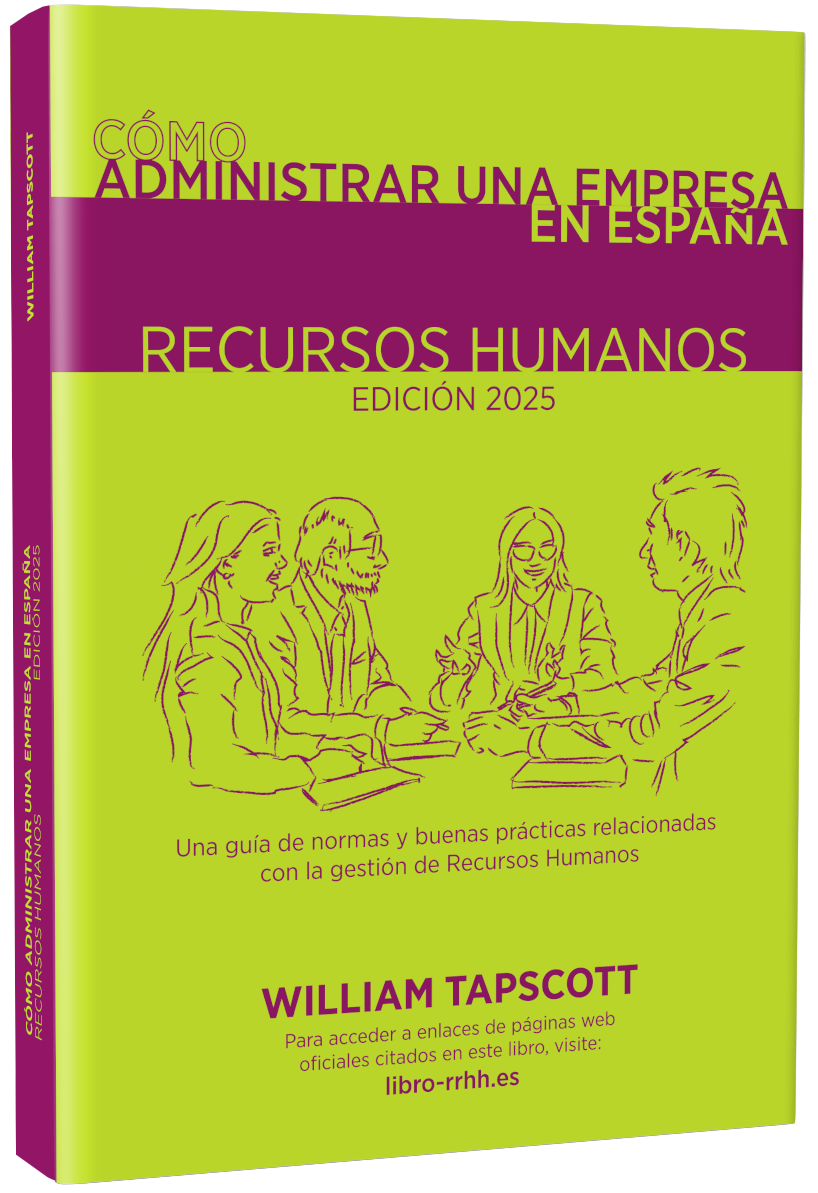
Managing Human Resources in Spain
William Tapscott
An essential guide to Spanish legislation, bureaucracy and business practices in the area of Human Resources.
TABLE OF CONTENTS

344 pages

15 x 2 x 23 cm
Click on these chapters to see their principal subdivisions
CHAPTERS
I. THE LEGAL STATUS OF AN EMPLOYEE
II. SALARIES AND OTHER LABOR COSTS
III. ANNUAL OBLIGATONS AND TASKS
IV. SPORADIC OBLIGATIONS AND TASKS
V. PLANS AND REGULATIONS
VI. REFERENCIAS Y AYUDAS
INDEX
I. THE LEGAL STATUS OF AN EMPLOYEE
A. Hiring a new employee
B. Las bajas con reserva del puesto
C. Las bajas definitivas
D. Temporary employment
E. Changes in working conditions
F. Remote work
G. Interns and apprentices
See the complete table of contents and oficial websites
THIS BOOK WAS WRITTEN FOR THE FOLLOWING PUBLIC:
■ General managers and other professionals who need a comprehensive understanding of managing personnel in Spain.
■ Directors, supervisors and others responsible for Human Resources who wish to compare their own knowledge with the subject matter presented in this book.
■ Up and coming professionals looking to expand their know-how in this area.
■ Students who need to have an idea of the day-to-day work involved in Human Resources.
■ Those who provide services to companies to better understand their needs in the realm of Human Resources.
■ Anyone interested in familiarizing themselves with the regulations and ways of doing things in Spain.
RECENT CHANGES
IN THIS BOOK
IN THE FIELD OF HUMAN RESOURCES IN SPAIN
The English version of this book is expected to be available in December. Recent changes in Spanish labor law include the following:
- Increases in the maximum bases for Social Security contributions.
- Changes in the Worders’ Statute
Parental leave due to the birth or adoption of a child is extended by one week before the child reaches one year of age and an additional two weeks are granted before he turns eight years old. In the case of single-parent families, the periods of leave are doubled, with the exception of the first six mandatory weeks.
El Consejo de Ministros aprobó el 29 de julio de 2025 la ampliación en tres semanas – de 16 a 19 – el permiso por nacimiento y cuidado del menor para cada progenitor y lo incrementó a 32 semanas para familias monoparentales. Ahora se distribuyen de la siguiente manera: 6 semanas obligatorias, 11 semanas adicionales hasta que el niño cumpla un año de edad y 2 semanas adicionales hasta que el niño cumpla 8 años de edad.
SPANISH VERSION
Enter here your email address if you’re interested in purchasing the 2027 edition of this book. You’ll be notified when it becomes available.
ABOUT THE AUTHOR
William Timothy Tapscott Simmons
C. Bilbao 21-23 , 08005 Barcelona
William Tapscott was born in Boston in 1949. He obtained his bachelor’s degree in economics from Tufts University in 1971 and an MBA from Columbia University in New York City in 1974. That same year he began to work for FMC Corporation in the same city. Three years later, FMC acquired Foret, S.A. in Barcelona and William was sent to Spain to prepare financial statements and analysis, budgets and other documents in the formats required by the American company.
Over the course of his career, William has worked in five Spanish companies, as well as at business schools, in the areas of Accounting, Finance and Human Resources. He retired in 2015 and now lives in Barcelona. He has both Spanish and American citizenship, is divorced and has two sons and two grandchildren, all living in Catalonia.